> ## Documentation Index
> Fetch the complete documentation index at: https://hastekit.ai/docs/llms.txt
> Use this file to discover all available pages before exploring further.
# Credentials & Secrets
> Encrypted per-project vault for OAuth client secrets, bot tokens, API keys, and webhooks
The **Credentials** store holds everything your agents need to authenticate against external services without exposing the actual secrets — to you, to other org members, or to the agent's prompt. Once saved, values are masked in the UI and never returned by the API.
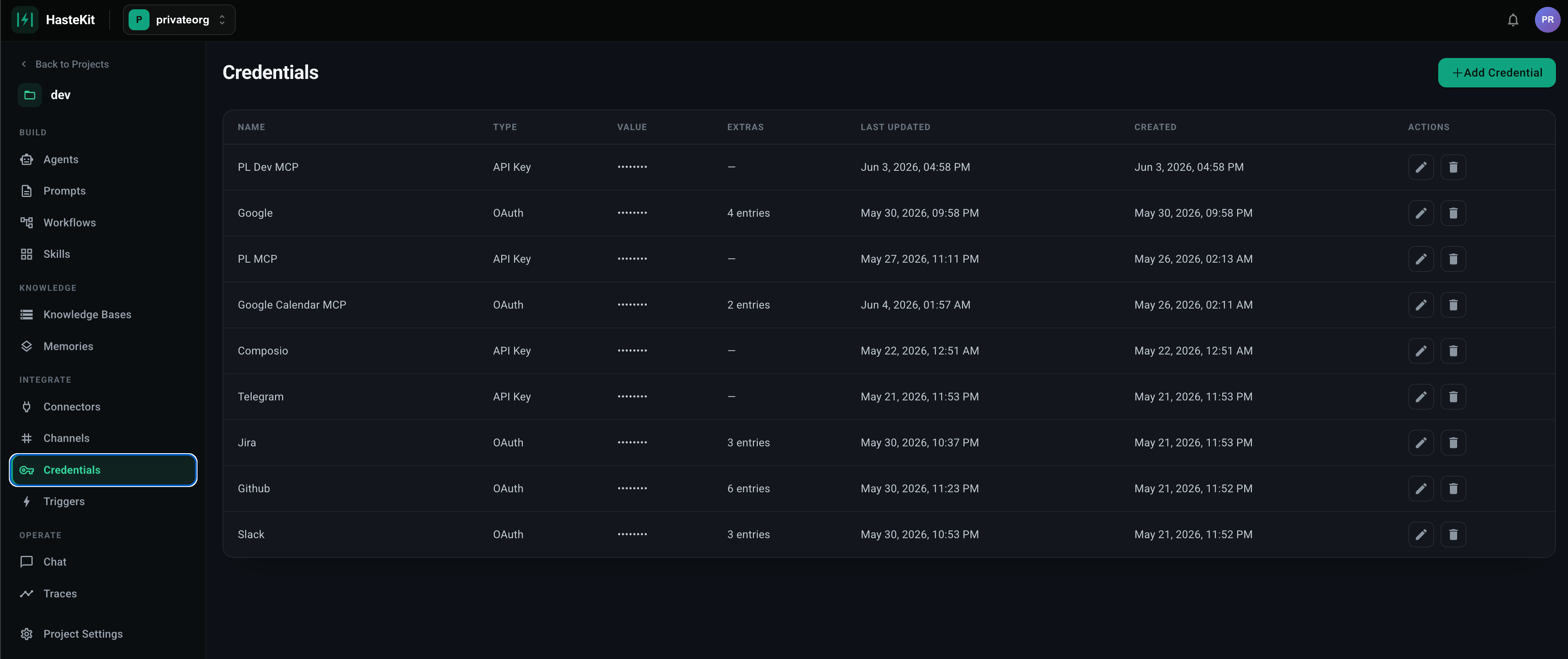 ## What's stored here
* **OAuth client IDs and secrets** for third-party apps registered as [Connectors](/docs/gateway/agent-builder/connectors).
* **Bot tokens** for [Channels](/docs/gateway/agent-builder/channels) — Telegram bot tokens, Slack signing secrets.
* **API keys** for [API Servers](/docs/gateway/agent-builder/api-servers) and outbound HTTP calls from [Workflows](/docs/gateway/agent-builder/workflows).
* **Webhook URLs** with embedded auth.
* Any other secret value that your agents or workflows reference.
## Adding a credential
1. Open **Agent Framework → Credentials**.
2. Click **Add Credential**.
3. Provide:
| Field | Description |
| ---------- | ---------------------------------------------------------------------------------------------- |
| **Name** | Unique within the project. Used to reference the credential from connectors, API servers, etc. |
| **Type** | `OAuth App`, `API Key`, `Bot Token`, `Webhook`, or `Custom`. Determines which fields appear. |
| **Fields** | Key-value pairs (e.g. `client_id` + `client_secret` for an OAuth App; `token` for an API key). |
4. Save. Values are encrypted at rest. The UI shows only a masked preview on subsequent views.
## Using a credential
Anywhere HasteKit needs a secret — when you register a Connector, configure an API Server, attach a bot token to a Channel — you select the credential **by name** from a dropdown. The secret never appears in the agent's prompt, in traces, or in any API response.
## Security model
* Encrypted at rest with per-project keys.
* Masked in the UI after creation; values cannot be revealed once saved.
* Never serialized into traces or LLM prompts.
* Org-level RBAC determines who can create/update credentials (Owners and Collaborators).
## Rotating a secret
To rotate a secret without breaking dependent connectors/API servers:
1. Open the credential.
2. Click **Edit** and paste the new value(s).
3. Save. Everything that references the credential by name picks up the new value on the next call.
## Relation to Connectors
A [Connector](/docs/gateway/agent-builder/connectors) registers a third-party OAuth app and stores its `client_id` / `client_secret` *as a credential*. End users then authorize their own accounts (each authorization is a **connection** under the connector). The credential is the **app**; the connections are the **users** — both are scoped per project and managed independently.
## What's stored here
* **OAuth client IDs and secrets** for third-party apps registered as [Connectors](/docs/gateway/agent-builder/connectors).
* **Bot tokens** for [Channels](/docs/gateway/agent-builder/channels) — Telegram bot tokens, Slack signing secrets.
* **API keys** for [API Servers](/docs/gateway/agent-builder/api-servers) and outbound HTTP calls from [Workflows](/docs/gateway/agent-builder/workflows).
* **Webhook URLs** with embedded auth.
* Any other secret value that your agents or workflows reference.
## Adding a credential
1. Open **Agent Framework → Credentials**.
2. Click **Add Credential**.
3. Provide:
| Field | Description |
| ---------- | ---------------------------------------------------------------------------------------------- |
| **Name** | Unique within the project. Used to reference the credential from connectors, API servers, etc. |
| **Type** | `OAuth App`, `API Key`, `Bot Token`, `Webhook`, or `Custom`. Determines which fields appear. |
| **Fields** | Key-value pairs (e.g. `client_id` + `client_secret` for an OAuth App; `token` for an API key). |
4. Save. Values are encrypted at rest. The UI shows only a masked preview on subsequent views.
## Using a credential
Anywhere HasteKit needs a secret — when you register a Connector, configure an API Server, attach a bot token to a Channel — you select the credential **by name** from a dropdown. The secret never appears in the agent's prompt, in traces, or in any API response.
## Security model
* Encrypted at rest with per-project keys.
* Masked in the UI after creation; values cannot be revealed once saved.
* Never serialized into traces or LLM prompts.
* Org-level RBAC determines who can create/update credentials (Owners and Collaborators).
## Rotating a secret
To rotate a secret without breaking dependent connectors/API servers:
1. Open the credential.
2. Click **Edit** and paste the new value(s).
3. Save. Everything that references the credential by name picks up the new value on the next call.
## Relation to Connectors
A [Connector](/docs/gateway/agent-builder/connectors) registers a third-party OAuth app and stores its `client_id` / `client_secret` *as a credential*. End users then authorize their own accounts (each authorization is a **connection** under the connector). The credential is the **app**; the connections are the **users** — both are scoped per project and managed independently.